
On the 22nd of August, a brave team of RoAMers went out onto Tadham Moor, led by Bill Urwin, to monitor the local population of Large Marsh Grasshopper (Stethophyma grossum). We brought enthusiasm, we dressed wisely, given the weather forecast (apart from Bill). We looked mostly prepared, and we completed the survey without losing anyone. The group met cows, and we laughed to cover up our apprehension. All of us got damp, (especially Bill). With great skill, we helped each other over the worst of the muddy bits. We enjoyed ourselves.

There was doubt at the start of the day as to whether we would find any. We noted that very few had been seen on anyone’s wandering on the levels. As with any species, the numbers of Large Marsh Grasshopper will have peaks and troughs year to year. Second to this, the weather was not quite on our side, being a bit breezy and overcast when we set out.
The LMG is the UK’s largest native grasshopper. Beyond its size, its key identification feature is its red go-faster stripe along the rear of the thigh. It is also one of the rarest UK Orthoptera, it has a single stronghold in the New Forest and south Dorset bogs. Everyone thought it had disappeared from other areas of the country.
Into the Fields We Go
Our first field was a location that, in 2019, yielded the first rediscovery in Somerset by Fred. In the 1990s, it was declared extinct in Somerset. The weather was a bit on the cool and breezy side for finding Orthoptera, and our initial results showed that. The ten of us spread out to conduct a sweep of the whole field. We looked, to the untrained eye, like a rural and possibly inept CSI. Initially, the most notable observation was the lack of any sightings of anything. We tried harder and brought long-forgotten skills to bear.
A few members, including myself, were not familiar with the Large Marsh Grasshopper. Therefore, every at invertebrate movement we got excited – a potential sighting of the elusive beast. As most exciting bird spots end up in being a pigeon, so every invertebrate motion seemed to be a Cranefly. Not to put down craneflies, they are wondrous creatures equally deserving of our full attention. As we completed our lap, we had just one likely sighting of Large Marsh Grasshopper. Alan saw something scurrying quickly into the dense grass.
Roesel’s Bush Cricket to the Rescue
We did, however, spot Roesel’s Bush Cricket (Metrioptera roeselii). This species, confined to the South East coast of England until the 1900’s, has recently been spreading North and West. It is common across much of SE England, and is moving well into Cornwall, Wales, and northern England. One of its distinctive features is the pale line sweeping around the outside of the thorax..
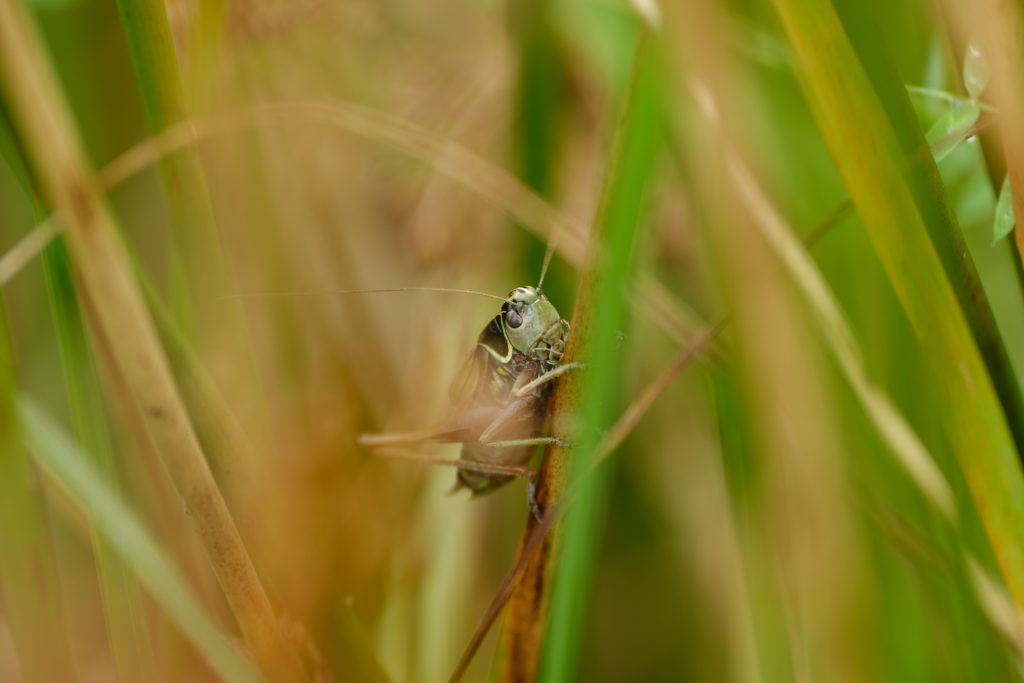
Undeterred, we moved on to the ‘Biblical’ field, so named for its vast numbers on the previous survey in 2019. We negotiated the Longhorn cattle, but we were forced to take shelter to wait out some strong rainfall . With Bill not being waterproof, and our target species being a definite fair-weather grasshopper we were close to retiring for the day. Luckily it was just a shower.
The Biblical Field
We think that the Biblical field was once a ‘medicine field’ – one high in botanical diversity. Farmers moved sickly animals there to graze, where they ate the additional nutrients needed to recover. It was certainly noticeably more diverse than the previous field and had great shelter from mature trees on every boundary.
The hype given to the field did not disappoint, and we found several Large Marsh Grasshoppers within the first few minutes. A full sweep resulted in 13, all males. Despite the slightly dull weather, one male was trying to start calling for a mate. He was perhaps put off by the sudden crowd around him. I don’t blame him for getting stage fright. This total, while much lower than previous totals we have accumulated, is probably good for the conditions on the day.
The Call of the Wild
The Large Marsh Grasshopper has a unique call that differs from other grasshoppers. It creates its sound on the upstroke of its hind leg rather than the downstroke, so it only produces a very short call, almost like someone making a kissing noise. I revisited the field a week later on a calm, sunny day. My ears could hear an uncountable number of males calling for mates in a number of leks. I stayed out of the field as I didn’t want to trample or disturb, but it was an incredible soundscape I’d never heard before.
The last observation that should be noted is the presence of the Wasp Spider (Argiope bruennichi). A very striking spider with an incredible web (look up Wasp Spider stabilimenta), but one that preys on grasshoppers. We have noticed
an increase in the numbers of this species year on year across the levels, and it is sure to have an impact on the Large Marsh Grasshopper, but one that will just have to be observed.


Our total was 14 LMGs, and 1 Wasp Spider. Big thanks to Bill for leading the day, and to all who turned out to scrabble about in the grass. We will be surveying in future years, so if you would like to join us, do get in touch.
Simon Keyte holds the copyright of all images in this report.