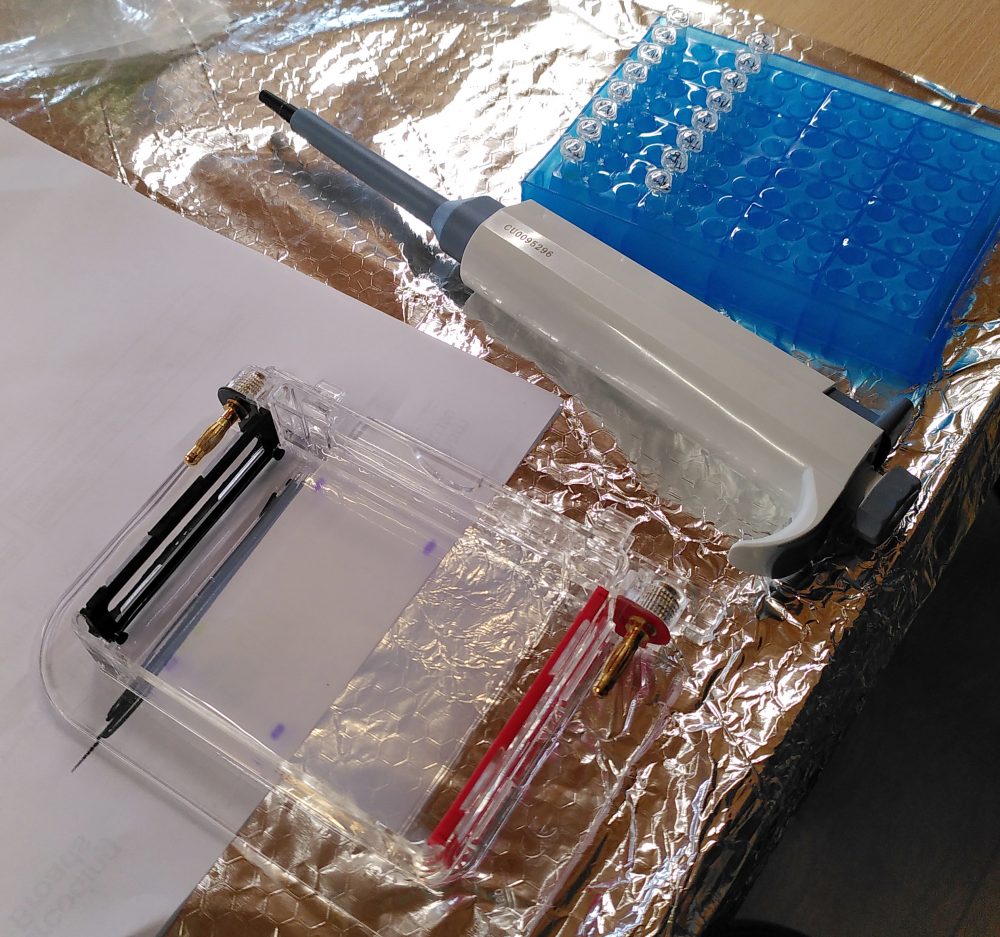
Following on from our successful involvement in the BIOSCAN Project, RoAM decided to take our research further. We applied for a grant that enabled us to run a course on DNA barcoding for several members of RoAM. We also acquired a BENTO LABS barcoding kit that is needed for sample preparation. This work is at the cutting edge of citizen science and is now firmly part of RoAM’s research efforts.
Filling the gel wells for electrophoresis
Fungi and lichen DNA
So far, we have concentrated on Fungi and Lichens as our main research area, as invertebrate bar-coding is adequately covered within the BIOSCAN Project. Our efforts have already produced new species for the UK. There are potentially new species to science within what we have sampled and sequenced so far. The method involves the collection of samples along with their associated data. A set of morphological photographs is produced for each specimen. Chemical tests, microscopic examination, and measurements add to the data. A tiny piece of the sample is then subjected to a process that releases and amplifies its DNA.
Contributing to science
The resultant sample is then sent off to Aberystwyth University, where it is sequenced. The results from Aberystwyth are compared to sequences from all over the world. These are held in the Barcode of Life Database (BOLD), but this database is by no means complete. As we add more of our data, we are aiding future researchers in unraveling the mysteries of life on Earth.
DNA session
Getting involved
If you are interested in the science of DNA extraction, then you are very welcome to join us at one of our session. Please use the enquiry form to contact us for more details.